
 Corporate Governance
Parkway Trust Management Limited, in its capacity as the manager of PLife REIT ("Manager") recognises that an effective corporate governance framework is crucial for the performance and business affairs of the Manager and therefore, maximising the success of PLife REIT. The Manager is firmly committed to good corporate governance and has adopted a comprehensive corporate governance framework that meets best practice principles. In particular, the Manager has an obligation to act with due care and diligence, and in the best interests of the unitholders of PLife REIT ("Unitholders").
The following sections describe the Manager's main corporate governance policies and practices with reference to the Code of Corporate Governance 2018 (as amended, "CG Code"). The Manager confirms that it has complied with the CG Code in all material respects and to the extent that there are any deviations from the CG Code, the Manager will provide explanation for such deviation and details of the alternative practices which have been adopted by the Manager which are consistent with the intent of the relevant principle of the CG Code.
THE MANAGER OF PLIFE REIT
PLife REIT, constituted as a trust and has no personnel of its own, is externally managed by the Manager in accordance with the terms of the trust deed constituting PLife REIT dated 12 July 2007 (as amended, the "Trust Deed"). The Manager appoints experienced and well-qualified management personnel to handle its current business and operations. All directors and employees of the Manager are remunerated by the Manager, and not PLife REIT.
The Manager has general powers of management over PLife REIT and its main responsibility is to manage PLife REIT's assets and liabilities for the benefit of Unitholders.
The Manager sets the strategic direction of PLife REIT and makes recommendations to the trustee of PLife REIT ("Trustee") on the acquisition, divestment and enhancement of assets of PLife REIT in accordance with its investment strategy.
Other main functions and responsibilities of the Manager are as follows:
- uses its best endeavours to carry on and conduct its business in a proper and efficient manner, to ensure that the business of PLife REIT is carried on and conducted in a similar manner, and to conduct all transactions with or for PLife REIT at arm's length and on normal commercial terms;
- ensures compliance with the Trust Deed and applicable laws and regulations, including the Securities and Futures Act 2001 of Singapore ("SFA"), the listing manual ("Listing Manual") of the Singapore Exchange Securities Trading Limited ("SGX-ST"), the Code on Collective Investment Schemes ("CIS Code") issued by the Monetary Authority of Singapore ("MAS") which includes the Property Funds Appendix in Appendix 6 of the CIS Code (the "Property Funds Appendix") and the tax ruling issued by the Inland Revenue Authority of Singapore on the taxation of PLife REIT and its Unitholders; and
- attends to all regular communications with Unitholders.
The Trust Deed outlines certain circumstances under which the Manager can retire in favour of a corporation approved by the Trustee to act as the manager of PLife REIT or the Manager can be removed by notice given in writing by the Trustee upon the occurrence of certain events. A copy of the Trust Deed is available for inspection by the Unitholders at the registered office of the Manager during usual office hours1.
BOARD MATTERS
The Board's Conduct of Affairs
Principle 1: The company is headed by an effective Board which is collectively responsible and works with Management for the long-term success of the company.
The board of directors of the Manager ("Board") is responsible for the overall leadership and oversight of the management and corporate governance of the Manager, including setting strategic corporate strategy and directions of the Manager, overseeing the proper conduct of the Manager and ensuring that senior management provides business leadership while demonstrating the highest quality of management skills with integrity and enterprise. All Board members participate in matters relating to corporate governance, business operations, risk management, financial performance and the nomination and review of directors. The Board has approved a framework for the management of the Manager, including a system of internal controls and business risk management process that enables risks to be assessed and managed.
The Board meets regularly, at least once every quarter, to deliberate on the strategic objectives and policies of PLife REIT. Matters requiring the Board's decision and approval include investments, acquisitions and disposals, major leases and assets enhancement works, operating and capital expenditure, loan or debt financing or refinancing taking into consideration PLife REIT's commitment in terms of capital and other resources, the annual budget, the release of the quarterly business updates, semi-annual and full year results, the appointment of directors and other material transactions. Such matters have been clearly communicated to the management in writing. The Board also reviews the financial performance of PLife REIT against approved budget, assesses material risks to the assets and business operations of PLife REIT, examines liability management, and acts on any comments from the auditors of PLife REIT. Where necessary, additional Board meetings are held to address significant transactions or issues.
In discharge of its functions, the Board is supported by an Audit and Risk Committee ("ARC") that provides independent oversight of the Manager. The Board is also supported by a Nominating and Remuneration Committee ("NRC") which oversees the remuneration matters of the directors and key management personnel of the Manager, nomination of directors and the effectiveness of the Board. Each Board committee operates under delegated authority of the Board and is governed by its respective terms of reference approved by the Board.
The Board has adopted a set of internal controls which it believes is adequate in safeguarding Unitholders' interests and PLife REIT's assets. Appropriate delegation of authority has been given to management to facilitate operational efficiency.
The Board recognises that all directors of the Manager have fiduciary duties to act objectively in the best interests of PLife REIT and hold the management accountable for performance. As such, any director who has, or appears to have, direct or indirect interest that may conflict with any subject matter under discussion by the Board shall declare his interest and recuse himself from the information flow and discussion of the subject matter. He shall also abstain from any decision-making on the subject matter. The Manager has in place a code of conduct, which includes core values such as upholding ethical standards of professional practice, treating all internal and external parties with mutual respect and without prejudice, prohibiting any form of bribery and corruption, maintaining confidentiality regarding its business and avoiding conflicts of interest. All employees of the Manager are required to abide by the code of conduct, as well as policies and guidelines pertaining to employment and accountability.
The number of Board and Board committee meetings held during the financial year ended 31 December 2024 ("FY2024"), as well as the attendance of each Board member at these meetings, are set out below.

Changes to laws, regulations, accounting standards and commercial risks are monitored closely. To keep pace with regulatory changes that have an important bearing on the Manager's or directors' obligations, the directors will be briefed either during Board meetings or at specially-convened sessions with the relevant professionals. The directors are also encouraged to participate in seminars and/or training to keep abreast of the latest developments relevant to the Manager and PLife REIT. During FY2024, the directors were briefed on directors' duties and responsibilities by external solicitors engaged by the Manager. Mr. Tomo Nagahiro and Dato' Sri Muthanna Bin Abdullah attended the Sustainability E-Training for Directors provided by the Institute of Singapore Chartered Accountants (ISCA) (in partnership with SAC Capital). Dato' Sri Muthanna and Dr. Chow Chorng Ann Peter also attended the Essentials for Directors of REIT Managers course provided by the REIT Association of Singapore.
Newly-appointed director receives letter of appointment setting out his or her roles, duties and obligations as a director of the Manager. An orientation and induction programme will be conducted to provide each new director with information on the Board's structure and responsibilities, the overall strategic business plans and direction of PLife REIT, as well as the duties and statutory obligations of a director of the Manager. A newly-appointed director who has no prior experience as a director of Singapore listed company ("First-time Director") shall also attend mandatory training prescribed by the Listing Manual within a year from his or her appointment date. In this regard, Dr. Prem Kumar Nair and Dr. Chow Chorng Ann Peter who were appointed during FY2023 have completed the mandatory training programmes prescribed under the Listing Manual on 7 November 2024 and 9 October 2024 respectively. Ms. Theresa Goh Cheng Keow who is a First-time Director appointed in FY2024 will complete the training programmes prescribed under the Listing Manual by 24 October 2025 and was provided with an overview of PLife REIT and the Manager by the management as part of the orientation and induction programme.
The management provides the Board with complete and adequate information on the business and operations of PLife REIT and the Manager, on a regular and quarterly basis, at Board meetings.
The annual calendar of Board meetings is scheduled in advance. Board papers are circulated to directors in advance of the scheduled meetings, providing directors sufficient time to review and consider the matters being tabled and discussed at the meetings. Senior executives are also invited to attend Board meetings to provide insights into the matters being discussed and to respond to any queries from the directors.
The Board has separate and independent access to management and the company secretary at all times. The Board is entitled to request, and will be provided with, additional information from management in a timely manner as needed to make informed decisions. The company secretary is responsible for corporate secretarial administration, ensuring that procedural matters relating to the Board are adhered to and that applicable rules and regulations are complied with. The company secretary also attends all Board meetings. The appointment and removal of the company secretary is a Board reserved matter. Additionally, the Board has access to independent professional advice, where appropriate, at the Manager's expense.
BOARD COMPOSITION AND GUIDANCE
Principle 2: The Board has an appropriate level of independence and diversity of thought and background in its composition to enable it to make decisions in the best interests of the company
The Board currently consists of eight members, seven of whom are non-executive directors, including three independent directors. The Chairman of the Board is Mr. Ho Kian Guan. None of the directors has entered into any service contract directly with PLife REIT.
Current Director's Appointment and Membership on Board Committees
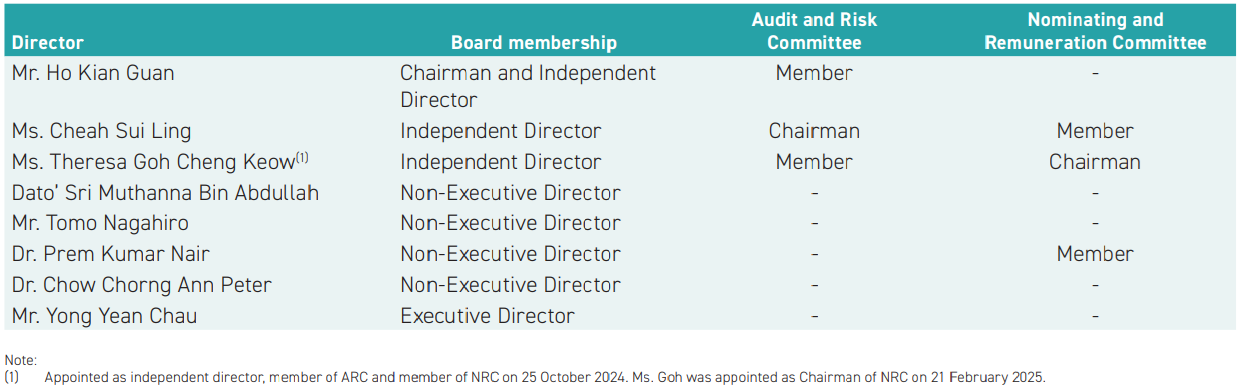
The composition of the Board is determined using the following principles:
- the Chairman of the Board and Chief Executive Officer ("CEO") should in principle be separate persons;
- the Board should comprise directors with a broad range of expertise and commercial experience (including expertise in funds management and the property industry), and knowledge of PLife REIT; and
- at least one-third of the Board should comprise independent directors.
Independent Directors
For FY2024, the Board had four independent directors out of a total of nine directors, namely Mr. Ho Kian Guan, Dr. Jennifer Lee Gek Choo, Ms. Cheah Sui Ling and Ms. Theresa Goh Cheng Keow. None of the independent directors has served beyond nine years on the Board.
When evaluating the independence of the directors, the Board takes into account the guidance in the CG Code where an "independent" director is defined as one who is independent in conduct, character and judgement, and has no relationship with the Manager, its related corporations, its substantial shareholders or its officers that could interfere, or be reasonably perceived to interfere, with the exercise of a director's independent business judgement in the best interests of the Manager and PLife REIT. Further, additional independence requirements are imposed under Regulations 13D to 13H of the Securities and Futures (Licensing and Conduct of Business) Regulations ("SFLCB Regulations"). Under the SFLCB Regulations, a director is considered to be independent if the director (i) is independent from the management of the Manager and PLife REIT; (ii) is independent from any business relationship with the Manager and PLife REIT; (iii) is independent from every substantial shareholder of the Manager and every substantial unitholder of PLife REIT; (iv) is not a substantial shareholder of the Manager or a substantial unitholder of PLife REIT; and (v) has not served as a director on the Board for a continuous period of 9 years or longer. The Chairman of the Board shall also not be an executive director or a person who is a member of the immediate family of the CEO.
As part of the annual review process, each independent director is required to provide a declaration of independence with regard to the independence criteria set out in the CG Code and the SFLCB Regulations. These declarations are submitted to the NRC and the Board for review. The NRC and the Board will also consider each independent director's views and conduct at both Board meetings and Board committee meetings in their assessment, including whether such independent director possesses personal attributes such as independent thinking and keen observation, and the ability to maintain integrity and strong principles. Additionally, they will assess the director's ability to question management, exercise constructive skepticism, and apply sound judgment.
For FY2024, the NRC conducted an annual review of the directors' independence, taking into consideration the independence criteria outlined in the CG Code and the SFLCB Regulations. The NRC considered that Mr. Ho Kian Guan, Dr. Jennifer Lee Gek Choo, Ms. Cheah Sui Ling and Ms. Theresa Goh Cheng Keow are independent, as they have each demonstrated independence of view and conduct at both Board meetings and Board committee meetings, and have consistently exercised independent judgment in the best interests of PLife REIT. Based on the NRC's review and recommendation, the Board concurred that Mr. Ho, Dr. Lee, Ms. Cheah and Ms. Goh are considered independent. As a result, at least one-third of the Board comprises independent directors.
The Board has considered the relevant requirements under the SFLCB Regulations and its views in respect of each of the directors as follows:
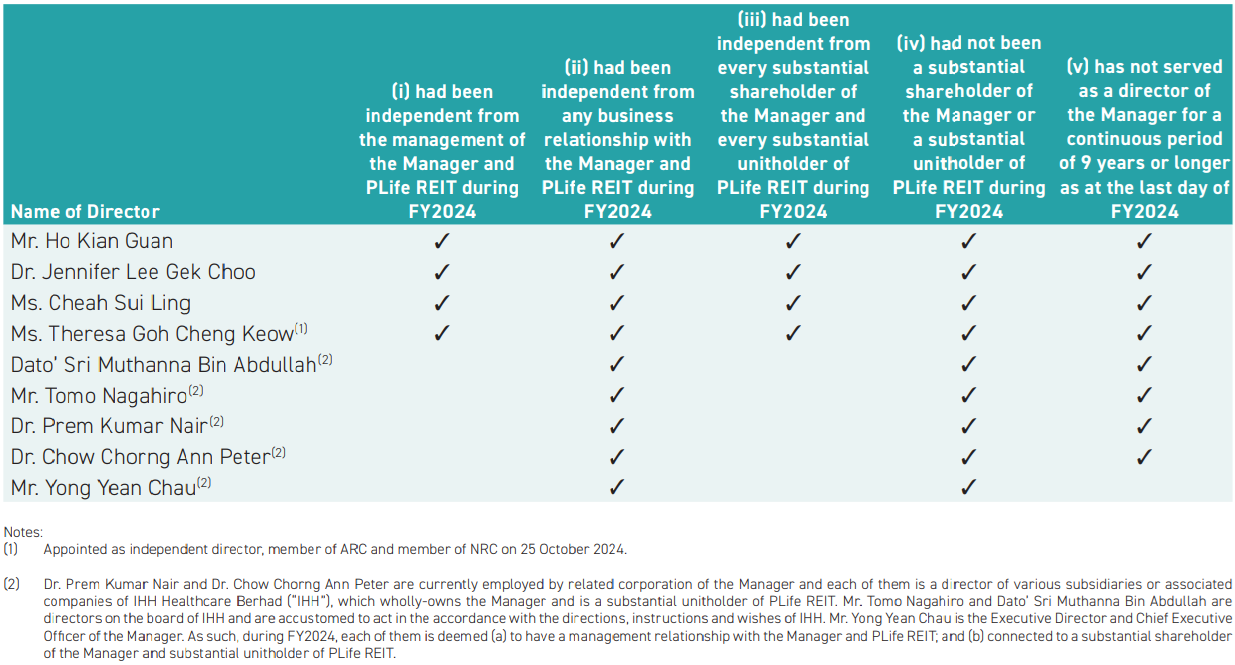
The Board of the Manager is satisfied that, as at 31 December 2024, each of the abovementioned directors was able to act in the best interests of all Unitholders of PLife REIT as a whole. For the purposes of Regulation 13E(b)(ii) of the SFLCB Regulations, as at 31 December 2024, each director was able to act in the best interests of all the Unitholders as a whole.
The Board has not appointed a lead independent director given that the Chairman is an independent director who is not part of the management team, as described under section of "Chairman and CEO" below.
Non-executive Directors
Non-executive directors do not exercise any management functions in the Manager, PLife REIT or any of its subsidiaries. Although all directors share equal responsibility for the performance of the Manager and PLife REIT, the role of the non-executive directors is particularly important in ensuring that the management's performance in meeting agreed goals and objectives is reviewed, and that the performance reporting is monitored. Additionally, the strategies proposed by management are fully discussed, rigorously examined and developed, with careful consideration on the long-term interests of PLife REIT's assets and the Unitholders. The non-executive and/or independent directors meet regularly without the presence of management as needed, and feedback from these meetings is communicated by the chairman of such meetings to the Chairman of the Board or the Board, as appropriate.
The majority of the directors are non-executive and/or independent of management. This enables the management to benefit from their external, diverse and objective perspectives on issues brought before the Board. It also allows the Board to engage with management through a robust exchange of ideas and views, helping to shape the strategic direction. This, along with a clear separation of roles of the Chairman and CEO, as described below, fosters a healthy professional relationship between the Board and management, with clear roles and robust oversight as they deliberate the business activities of the Manager.
Board Diversity
The Manager recognises and embraces the benefits of having a diverse Board and views increasing diversity at Board level as essential element for maintaining a competitive advantage. With the recommendation of the NRC, the Board has adopted a board diversity policy that outlines the approach to diversity on the Board, including gender, age, cultural background and ethnic diversity. The Board Diversity Policy is considered when determining the optimum composition of the Board, aiming for an appropriate balance where possible. All Board appointments are made based on merit, taking into account skills and experience. The Board recognises that Board diversity is crucial to the sustainable development of the Manager and emphasises the importance of Board diversity to manage the diversified business portfolio of the Manager and/or PLife REIT. The Board takes necessary measures to ensure that Board diversity will be considered in every Board appointment as well as annual assessment.
The composition of the Board is regularly reviewed to ensure it has the appropriate mix of expertise, experience and size. In conducting this review, the Board strives to achieve a balanced representation of skill, experience, age, cultural background and gender.
For FY2024, the Board comprised nine members (including three female directors) from diverse backgrounds, expertise and experience including finance, banking, investment, legal, real estate, healthcare business and operations, organisational and leadership development and business and general management. Prior to appointments, the Board considers candidates based on merit against objective criteria, with due regard on the benefits of diversity. At the recommendation of the NRC, the Board has committed to maintaining at least 25% female directors on a best efforts basis with a view to increasing to 30% over time to achieve greater gender parity. Additionally, the Board is working towards achieving appropriate age, ethnic and cultural background diversity. The measures to achieve the desired Board diversity will be reviewed periodically, and the NRC will recommend changes to the Board, as appropriate.
The Board composition in terms of age, independence, tenure and gender as at 31 December 2024 are as follows:-
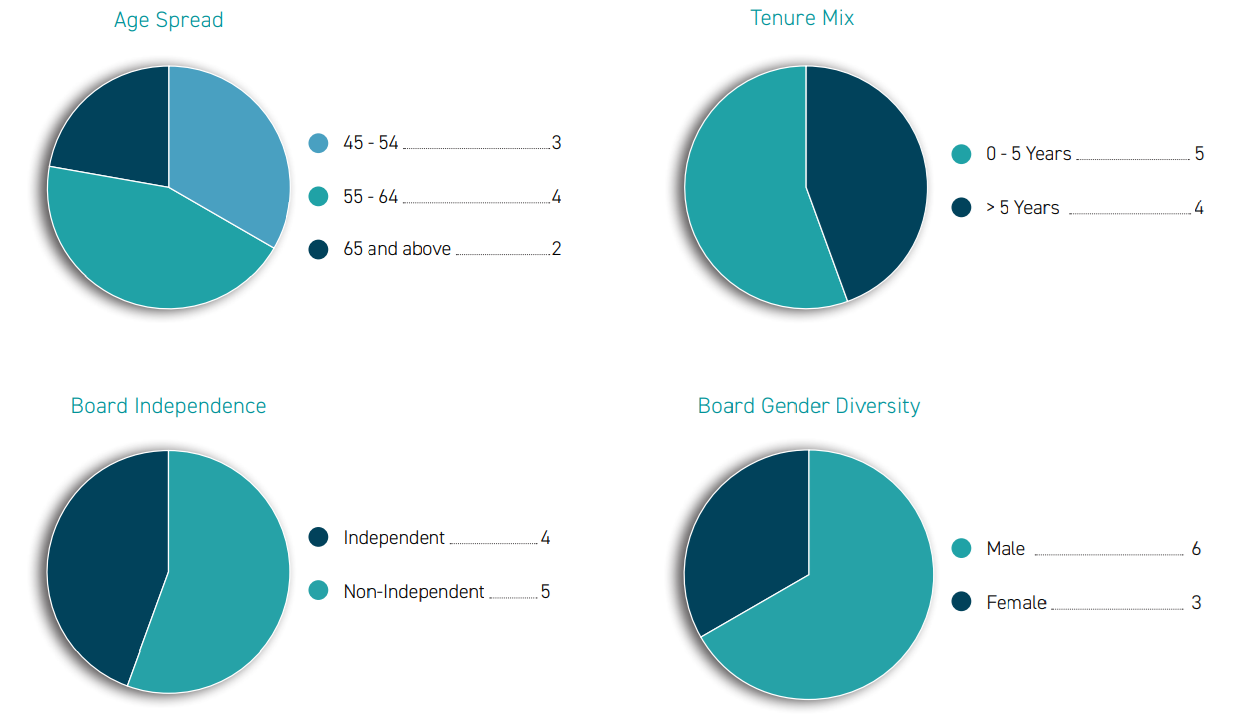
During FY2024, the Board reviewed its composition, level of independence and diversity, and is satisfied that the current size and composition are appropriate for facilitating effective decision-making and constructive debate. This takes into account the scope and nature of the Manager's and PLife REIT's operations, the business requirements and the need to avoid undue disruptions from changes to the composition of the Board and its committees.
The profiles of the directors are set out on pages 16 to 23 of this Annual Report.
CHAIRMAN AND CHIEF EXECUTIVE OFFICER
Principle 3: There is a clear division of responsibilities between the leadership of the Board and Management, and no one individual has unfettered powers of decision-making.
The positions of Chairman and CEO are held by two separate individuals to maintain an effective check and balance, ensuring increased accountability and greater capacity for independent decision making by the Board. The Chairman of the Board, Mr. Ho Kian Guan is an independent director. The CEO is Mr. Yong Yean Chau who is also an executive director of the Manager. The Chairman and the CEO are not immediate family members and are not related to each other.
There is a clear and written separation of the roles and responsibilities between the Chairman and the CEO. The Chairman is responsible for the overall management of the Board, ensuring that the directors and management work together with integrity and competence, and that the Board engages with management in constructive debate on strategy, business operations, enterprise risk and other plans. The Chairman also ensures effective communication with the Unitholders and takes a leading role in promoting high standards of corporate governance with the support of the Board and management.
The CEO has full executive responsibilities over the business directions and operational decisions in the day-to-day management of the Manager and PLife REIT.
BOARD MEMBERSHIP
Principle 4: The Board has a formal and transparent process for the appointment and re-appointment of directors, taking into account the need for progressive renewal of the Board.
The Board has a formal and transparent process for the appointment and re-appointment of directors, considering the need for progressive renewal of the Board. The Board is supported by the NRC on matters related to the appointment and succession of Board members, Board effectiveness and directors' independence.
For FY2024, the NRC of the Manager consisted of Dr. Jennifer Lee Gek Choo (Chairman of the NRC), Ms. Cheah Sui Ling and Ms. Theresa Goh Cheng Keow, all of whom are non-executive and independent directors, as well as Dr. Prem Kumar Nair, a non-executive director. The NRC meets at least once a year to deliberate on remuneration matters, as well as matters related to the appointment and succession of Board members, Board performance evaluation and directors' independence.
The NRC has a set of terms of reference that define its scope of responsibility and authority, which includes the following:
- reviewing and recommending to the Board a framework for the remuneration of key management personnel, and determining specific remuneration packages for the Board and key management personnel covering all aspects of remuneration, including but not limited to directors' fees, salaries, allowances, bonuses, options, unit-based incentives, awards and benefits-in-kind;
- reviewing the appropriateness of remuneration awarded to attract, retain and motivate the executive director and key management personnel required to manage the Manager and PLife REIT successfully;
- reviewing the remuneration and employment conditions within the industry, as well as those of the peer companies, to ensure that the executive director and key management personnel are adequately remunerated;
- reviewing the adequacy and form of remuneration for the directors and key management personnel to ensure that the remuneration realistically commensurate with the responsibilities and risks involved in being an effective member, as well as corporate and individual performance;
- considering the eligibility of the executive director and key management personnel for benefits under long-term incentive schemes and the administration thereof;
- reviewing the use of long-term incentives, including share schemes, for the executive director and key management personnel;
- recommending to the Board on the selection, appointment and re-appointment of directors (including alternate directors, if applicable);
- recommending to the Board the review of the Board succession plans for the directors, in particular, the Chairman and CEO;
- undertaking the assessment of the effectiveness of the Board as a whole, the Board committees, and the contribution of the Chairman and each individual director to the Board's effectiveness;
- recommending training and professional development programs for the Board; and
- determining the independence of each director annually, and when circumstances require, and providing its views to the Board for consideration.
The appointment of director is a matter reserved for Board approval. The search for candidates is conducted through contacts and recommendations. The NRC will evaluate and assess the candidate based on the directors' criteria approved by the Board, as well as the candidate's academic and professional qualifications, expertise, commercial experience and knowledge, taking into account the scope and nature of the Manager's and PLife REIT's operations. Suitable candidates are then recommended by the NRC to the Board for approval. The Board will deliberate and review the proposed appointment of a new director, taking into account the NRC's recommendation. Such an appointment is subject to the approval of MAS. A formal letter outlining the director's duties and responsibilities will be given to the new director upon his/her appointment to the Board.
As the Manager is not a listed company, directors of the Manager are not subject to periodic retirement by rotation. Pursuant to an undertaking issued by Parkway Holdings Limited as the sole shareholder of the Manager to the Trustee on 16 March 2017 ("Undertaking"), Unitholders are given the right to endorse the appointment of the directors of the Manager by way of ordinary resolution at the annual general meetings ("AGM") of Unitholders. Accordingly, approximately one-third of the directors of the Manager are put forth for the Unitholders' endorsement of appointment during PLife REIT's AGM since 2017. If any director's appointment is not being endorsed by the Unitholders at the AGM, such director shall resign from the Board either (i) within 21 days from the date of the relevant AGM or (ii) in the event that the Board determines that a replacement director has to be appointed, no later than the date when such replacement director is appointed. Pursuant to Rule 720(6) of the Listing Manual, information regarding the directors who will be subject to Unitholders' endorsement or re-endorsement at the upcoming AGM is provided on pages 85 to 89 of this Annual Report.
The Board, through the NRC, reviews the succession plans of the Board and management on an annual basis, particularly the succession planning for the independent directors of the Manager. In view of the regulatory requirement that an independent director of the Manager shall not be appointed for a continuous period of 9 years or longer on the Board, the NRC has set an internal timeline to commence the search for a replacement independent director as early as one year before the retirement of the current independent director. This timeline ensures that sufficient time is allocated to find a suitable replacement, thereby maintaining the continuity and sustainability of the Board.
Management continuity is also a key priority to the Board to ensure business continuity and the sustainability of the Manager. As part of the management succession plan, the business critical roles ("BCR") of the Manager and their successors are identified. The BCR and the identified successors have been undergoing on-going, on-the-job development, with increased job responsibilities and wider exposure to the Board. In addition to the on-going job development, a leadership development plan approved by the NRC is in place to enhance the readiness of the identified successors for the BCR. The leadership development plan includes short courses focused on specific areas such as leadership skills, people management and business management, as well as executive or advanced management programmes offered by well-established universities or service providers.
BOARD PERFORMANCE
Principle 5: The Board undertakes a formal annual assessment of its effectiveness as a whole, and that of each of its board committees and individual directors.
A review of the Board's performance is conducted annually to assess the effectiveness of the Board and the Board committees. The review includes an evaluation of the Board composition, directors' contribution and commitment at board meetings, access to information, procedures, accountability and standards of conduct, skills and any specific areas where improvement may be needed by an individual director and the Board collectively. Attendance at meetings and the contributions of each director to the Board are also considered. The Board has not engaged an external facilitator to conduct the assessment. Each director is required to complete a questionnaire evaluating the Board and the Board committees for the financial year under review. A summary of the feedback and recommendations from the directors was prepared and presented to the NRC and the Board respectively. The NRC has reviewed the summary and provided its comments and recommendations, if any, to the Board for approval.
The Board has also established a general policy that a director should not hold more than five listed company board representations concurrently, taking into account market practices and the level of commitment required. This ensures that the Board functions effectively as a whole and that each director is able to dedicate sufficient time and attention to the affairs of PLife REIT and the Manager, including attending and contributing to Board meetings.
The Board and the NRC assessed the effectiveness and performance of the Board and the Board committees on an annual basis. Based on attendance and the level of participation at Board and the Board committee meetings held during the financial year, the Board is satisfied with its effectiveness and the commitment demonstrated by all directors. Each director has contributed effectively to the Board and has been able to adequately and diligently carry out their duties.
REMUNERATION MATTERS
Principle 6: The Board has a formal and transparent procedure for developing policies on director and executive remuneration, and for fixing the remuneration packages of individual directors and key management personnel. No director is involved in deciding his or her own remuneration.
Principle 7: The level and structure of remuneration of the Board and key management personnel are appropriate and proportionate to the sustained performance and value creation of the company, taking into account the strategic objectives of the company
Principle 8: The company is transparent on its remuneration policies, level and mix of remuneration, the procedure for setting remuneration, and the relationships between remuneration, performance and value creation.
As highlighted above, the NRC reviews and recommends to the Board a general framework for the remuneration of the Board and key management personnel. In line with the current practice, the NRC also reviews and recommends to the Board the specific remuneration packages for each director and key management personnel ("KMP") to ensure that the remuneration payable aligns with the objectives of the Manager's remuneration guidelines. For the avoidance of doubt, the NRC members do not participate in any decisions concerning their own remuneration.
The directors' fees and remuneration of employees of the Manager are paid in its own capacity using its own funds and fees received from PLife REIT and not from the funds of PLife REIT.
The Manager advocates a performance-based remuneration system for its staff. The NRC, which has an independent majority, ensures that there is an effective and formal process in place to establish the remuneration system. The remuneration of the KMP is reviewed by the NRC annually, based on both financial and non-financial key performance indicators ("KPIs") linked to the performance of PLife REIT for the financial year under review, as well as individual performance of each KMP in contributing to the long-term strategic goals of PLife REIT and the Manager. The financial KPI includes the distributable income of PLife REIT, while the non-financial KPIs include analyst coverage, tenant satisfaction, retention of key employees and regulatory compliance ("Performance Criteria").
The remuneration for the KMP consists of fixed pay and short-term and long-term incentives. The fixed pay component includes fixed salary and allowances. The short-term and long-term incentives are linked to the individual performance, based on their value creation capability, being the ability to contribute and achieve the Performance Criteria in their respective roles, as well as the overall performance of PLife REIT for the financial year.
The Performance Criteria and its target were approved by the Board prior to each financial year. Under the long-term incentive plan ("LTI Plan"), the eligible employee will be awarded with the PLife REIT's units owned by the Manager based on the achievement of the Performance Criteria for the financial year under review.
The LTI Plan is designed to enhance executive performance, encourage talent retention and provide eligible employees with a personal, direct interest in PLife REIT, thereby creating better alignment of the interest between management and the interest of the Unitholders. The LTI Plan also serves to motivate eligible employees to achieve the performance targets of PLife REIT. The Manager believes that the LTI Plan will make its remuneration package sufficiently competitive to recruit, reward, retain and motivate outstanding employees, which are paramount to achieving the Manager's long-term objective of sustainable returns for the Unitholders.
The non-executive directors receive their directors' fees based on their contributions, taking into account factors such as their responsibilities, effort and time spent serving on the Board and the Board committees, as well as their value creation capability. This includes the directors' ability to provide valuable experience and expertise in various aspects of PLife REIT's operations and offer stewardship to PLife REIT and the management of the Manager. The fees received by non-executive directors are at fixed rates and are determined by the shareholder of the Manager on an annual basis. In addition to their basic fee, the non-executive directors who hold the position of chairman of the Board or any Board committee are paid an additional fee. For the avoidance of doubt, the CEO of the Manager, who is also an executive director, does not receive any director's fee. None of the directors is involved in decisions concerning their own remuneration. The NRC also ensures that non-executive directors are not over-compensated to the extent that their independence may be compromised. In discharging its duties, the NRC may seek advice from external consultants whenever deemed necessary.
During the financial year under review, an external independent remuneration consultant, HR Guru Pte. Ltd., was engaged to review the competitiveness of the remuneration payable to the Manager's non-executive directors and employees. The remuneration consultant has no relationships with the Manager or its directors that would affect its independence and objectivity.
Disclosure of Remuneration
The directors' fee structure of the Manager for the financial year under review is as shown in the table below:-

The remuneration paid to the non-executive directors for FY2024 is as follows:
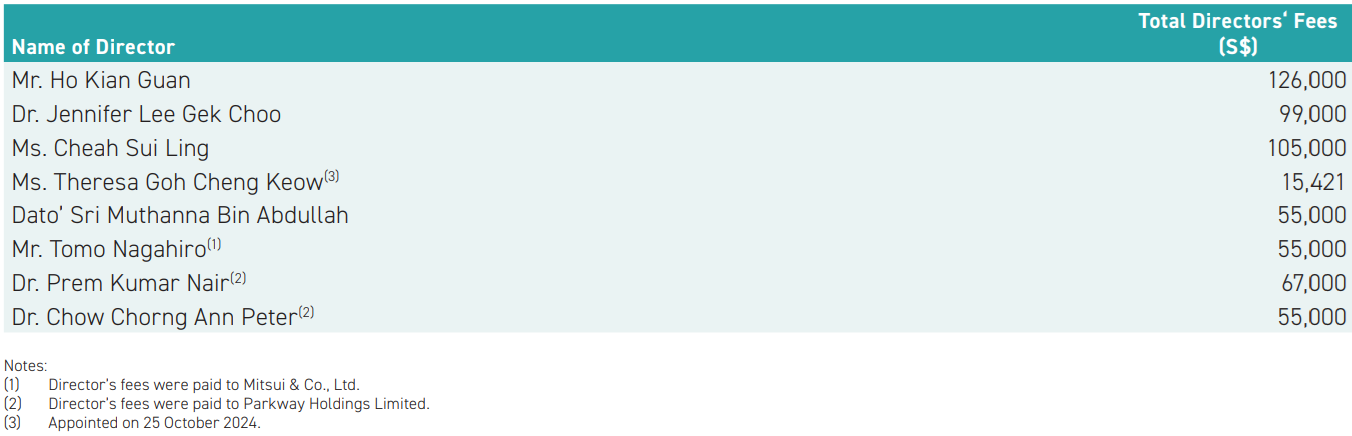
The remuneration of the non-executive directors is paid wholly in cash. Save as disclosed above, the non-executive directors do not receive any salary, performance-related income or bonuses, benefits-in-kind or any other long-term incentives.
The remuneration of the CEO and top 5 key executives of the Manager for FY2024 is as follows:
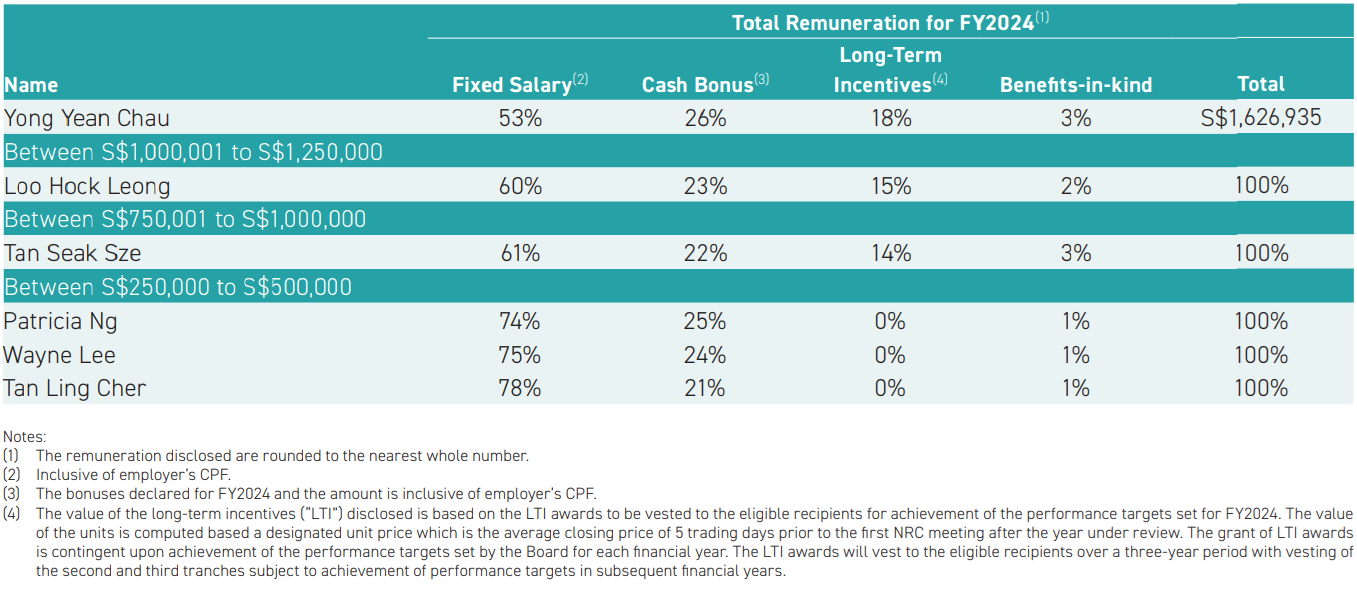
The total remuneration of top 5 key executives (excluding CEO) for FY2024 was approximately S$3.2 million.
No director or KMP of the Manager is paid in the form of shares or interests in the Manager's controlling shareholder or its related entities.
The NRC considers all aspects of remuneration, including termination terms, to ensure they are fair. For FY2024, there were no termination, retirement and post-employment benefits granted to the directors and KMP other than the payment in lieu of notice in the event of termination specified in the employment contract of the KMP.
No employee of the Manager was a substantial unitholder of PLife REIT or an immediate family member of a director, the CEO/ executive director or a substantial unitholder of PLife REIT, and whose remuneration exceeded S$100,000 during FY2024. "Immediate family member" means the spouse, child, adopted child, stepchild, sibling and parent.
Remuneration Disclosures under the United Kingdom's Alternative Investment Fund Managers Regulations 2013 (as amended) (AIFMR)
The Manager is required under the AIFMR to make quantitative disclosures of remuneration. Disclosures are provided in relation to (a) the staff of the Manager; (b) staff who are senior management; and (c) staff who have the ability to materially affect the risk profile of PLife REIT.
All individuals included in the aggregated figures disclosed are rewarded in line with the Manager's remuneration policies.
The aggregate amount of remuneration awarded by the Manager to its staff in respect of FY2024 was approximately S$8.6 million. This figure comprised fixed pay of approximately S$5.9 million, variable pay of approximately S$2.5 million and allowances and benefits-in-kind of approximately S$0.2 million. There was a total of 25 beneficiaries of the remuneration described above.
In respect of FY2024, the aggregate amount of remuneration awarded by the Manager to its key executives (which are senior management and members of staff whose actions have a material impact on the risk profile of PLife REIT) was approximately S$4.8 million, comprising 6 individuals identified having considered, among others, their roles and decision-making powers.
RISK MANAGEMENT AND INTERNAL CONTROLS
Principle 9: The Board is responsible for the governance of risk and ensures that Management maintains a sound system of risk management and internal controls, to safeguard the interests of the company and its shareholders.
The Board acknowledges its responsibility in the overall internal control framework and the maintenance of a sound system of internal controls. The system includes, among other things, enterprise risk management and internal auditing. However, the Board recognises that no cost-effective internal control system or risk management process can preclude all errors and irregularities. A system is designed to manage, rather than eliminate, the risk of failure to achieve business objectives, and it can provide only reasonable and not absolute assurance against material misstatement or loss.
The Manager has appointed experienced and well-qualified management personnel to handle the day-to-day operations of the Manager and PLife REIT. In assessing business risks, the Board considers the economic environment and risks relevant to the property and healthcare industries. It reviews management reports and feasibility studies on investment risks before approving any investment decisions. The Board meets regularly to review the operations of the Manager, the business risks of PLife REIT, examine liability management and act upon any comments from the auditors of PLife REIT.
To ensure a robust risk management system is maintained, the Manager has implemented an Enterprise Risk Management ("ERM") framework and policies to identify the nature and extent of significant financial, operational, compliance and information technology risks, in order to achieve strategic objectives and value creation of PLife REIT. An outline of the Manager's ERM framework and policies is provided on pages 63 to 65 of this Annual Report. Any material non-compliance and internal control weaknesses, along with recommendations to address them, as well as any mitigating controls or gaps (if any), are also presented to the ARC and the Board.
The system of risk management is embedded within the Manager's internal control system to address ongoing changes and challenges, and to reduce uncertainties to PLife REIT. The ARC, with the assistance of internal and external auditors, as well as an external risk consultant, reviews and reports to the Board on the adequacy and effectiveness of the Manager's internal control systems, including financial, compliance, operational and information technology controls.
The ARC and the Board review the adequacy and efficiency of the risk management system and internal controls on an annual basis. Based on the most recent evaluation of the controls conducted by the internal and external auditors, as well as the external risk consultant, the CEO and the Chief Financial Officer2 ("CFO") of the Manager have provided written assurance to the Board that the financial records of PLife REIT have been properly maintained and that the financial statements present a true and fair view of the operations and finances of PLife REIT for FY2024. The CEO, CFO and the Chief Investment Officer (collectively as the KMP) have also provided the Board with written assurance that the Manager's internal controls and risk management systems are effective and adequate for the year under review.
Nonetheless, the ARC will:
- satisfy itself, by such means as it shall consider appropriate, that adequate counter measures (i.e. mechanisms and processes, such as sound internal control systems) are in place to identify and mitigate any material business risks associated with the Manager and PLife REIT;
- ensure that a review of the effectiveness and adequacy of the Manager's internal controls, including financial, operational, compliance and information technology controls, and risk management policies and systems, is conducted at least annually. Such review can be carried out by internal auditors, external auditors and/or the ERM committee;
- ensure that the internal control recommendations made by internal auditors, external auditors and/or the ERM committee have been implemented by the Manager; and
- ensure that the Board is in a position to comment on the adequacy of the internal controls of the Manager.
The Board believes that the ERM framework is adequate and effective, considering the size of PLife REIT and the business environment in which it operates. The Board has also observed that management, being familiar with the ERM framework, implements it effectively and provides the ARC and the Board with timely updates on risk management activities. With regard to the Manager's internal controls, the Board is confident that these internal controls are audited annually by both internal and external auditors, and any lapses in internal controls are promptly brought to the Board's attention for corrective measures to be implemented as soon as practicable.
Taking into account the abovementioned evaluation of the controls conducted by the internal and external auditors as well as the external risk consultant, the review performed by the Manager's ERM committee, and the assurance received from the KMP of the Manager, the Board is of the opinion that PLife REIT's internal controls (including financial, operational, compliance and information technology controls) and risk management systems in place were adequate and effective as at 31 December 2024. The ARC concurs with the Board's comment regarding PLife REIT's internal controls (including financial, operational, compliance and information technology controls) and risk management systems as outlined above. For FY2024, the Board and the ARC have not identified any material weaknesses in the Manager's internal controls and risk management systems.
AUDIT AND RISK COMMITTEE
Principle 10: The Board has an Audit Committee which discharges its duties objectively.
For FY2024, the Audit and Risk Committee ("ARC") of the Manager consisted of Ms. Cheah Sui Ling (Chairman of the ARC), Dr. Jennifer Lee Gek Choo, Mr. Ho Kian Guan and Ms. Theresa Goh Cheng Keow, all of whom are independent non-executive directors. The members of the ARC collectively possess recent and relevant expertise or experience in financial management and are appropriately qualified to discharge their responsibilities.
The ARC has oversight responsibilities in key areas, including the financial reporting process and integrity, risk management and internal controls (including financial, operational, compliance and information technology controls), management of financial and fraud risks, the internal and external audit process (including scope, resources effectiveness and independence), whistle-blowing policies, processes and reporting, interested parties transactions and reporting, and the Manager's process for monitoring compliance with the laws, regulations and its code of business conduct. The ARC members meet at least once every quarter to deliberate on matters under its responsibility.
The ARC has a set of terms of reference that define its scope of responsibility and authority, which includes the following:
- reviewing the adequacy and effectiveness of the internal controls and risk management systems, including financial, operational, compliance and information technology controls, at least annually;
- reviewing with management the effectiveness of the system for monitoring compliance with laws and regulations (including the Listing Manual and the Property Funds Appendix) and the results of management's investigation and follow-up (including disciplinary action) of any fraudulent acts or non-compliance;
- reviewing the policy and arrangements for concerns about possible improprieties in financial reporting or other matters, ensuring that there are mechanisms in place for such concerns to be safely raised, independently investigated, and for appropriate follow-up action to be taken;
- monitoring the procedures established to regulate related party transactions, including ensuring compliance with the provisions of the Listing Manual relating to "interested person transactions" and the provisions of the Property Funds Appendix relating to "interested party transactions";
- reviewing the assurance from the CEO and CFO on the financial records and financial statements, as well as the assurance from the KMP on the adequacy and effectiveness of the risk management and internal control systems;
- reviewing the adequacy, effectiveness, independence and objectivity, scope and results of the external auditors;
- reviewing external audit reports to ensure that, where deficiencies in internal controls or significant findings have been identified, recommendations made by the external auditors are received and discussed, and that appropriate and prompt remedial action is taken by management;
- reviewing the nature and extent of non-audit services performed by external auditors;
- making recommendations to the Board on the appointment, re-appointment and removal of the external auditors, as well as the remuneration and terms of engagement of the external auditors;
- reviewing, on an annual basis, the adequacy, effectiveness, independence, scope and results of the internal audit function, ensuring that the internal audit function is adequately resourced and staffed with individuals who have the relevant qualifications and experience, and that it has unfettered access to all documents, records, properties and personnel, including access to the ARC;
- reviewing internal audit reports at least twice a year to ensure that the guidelines and procedures established to monitor related party transactions have been complied with;
- meeting with external and internal auditors, without presence of management annually;
- investigating any matters within the ARC's terms of reference, as deemed necessary;
- reporting to the Board on material matters, findings and recommendations; and
- assisting the Board in reviewing the Manager's sustainability issues and approach to sustainability reporting, reviewing the Manager's environmental, social and governance ("ESG") framework, monitoring and managing ESG factors identified as material to the business, overseeing and managing the standards, management processes and strategies to achieve sustainability practices in collaboration with management, and assisting the Board in ensuring the establishment and maintenance of a sound system of sustainability governance and an appropriate sustainability framework, while providing updates and recommendations to the Board on sustainability issues.
The ARC has authority to investigate any matter within its terms of reference. It also has full access to, and co-operation from, the management and the discretion to invite any director or executive officer to attend its meetings.
During the year under review, the ARC has reviewed:
- quarterly business updates, half-yearly and full-year financial statements of PLife REIT before its announcement;
- reports on audit findings reported by the internal and external auditors;
- reports on material business risks of PLife REIT reported by the external risk consultant;
- sustainability report of PLife REIT;
- compliance work plan and updates reported by the compliance officer; and
- related party transactions of PLife REIT.
In addition, the ARC has conducted a review of all non-audit services provided by the external auditors and is satisfied that the nature and extent of such services will not prejudice the independence and objectivity of the external auditors. For FY2024, the aggregate amount of fees paid and payable by PLife REIT to the external auditors was S$463,000, comprising non-audit service fees of S$168,000 and audit service fees of S$295,000. In appointing the audit firms for the Group, the ARC is satisfied that PLife REIT has complied with Rules 712 and 715 of the Listing Manual.
The ARC meets with the external auditors, without the presence of management, at least once a year.
The ARC is briefed regularly on the impact of the new accounting standards on PLife REIT's financial statements by the external auditors.
The ARC does not comprise former partners or directors of the Manager's or PLife REIT's external auditors within a period of two years commencing on the date of their ceasing to be a partner or director of the external auditors, or hold any financial interest in the external auditors currently engaged by PLife REIT and the Manager.
INTERNAL AUDIT
The Manager has put in place a system of internal controls and procedures, including financial, operational, compliance and information technology controls, as well as risk management systems, to safeguard PLife REIT's assets, Unitholders' interests, and to manage risk.
The internal audit function of the Manager is currently outsourced to an independent assurance service provider, BDO Advisory Pte Ltd, Singapore, which is a member of the BDO International Limited, United Kingdom and forms part of the international BDO network of independent member firms. BDO conducts their internal audits based on the BDO Global Internal Audit Methodology which is consistent with the International Standards for the Professional Practice of Internal Auditing adopted by The Institute of Internal Auditors. The internal audit team is well-resourced and is led by an engagement partner who is also the Head of Risk Advisory Services in BDO Singapore with more than 20 years of audit and advisory experience and is a Chartered Accountant (Singapore), Certified Internal Auditor and Certified Information System Auditor.
The ARC reviews the adequacy and effectiveness of the internal auditor at least once a year. The ARC is satisfied that the internal auditor possesses the relevant qualifications and experience and has met the standards established by internationally recognised professional bodies, including the Standards for the Professional Practice of Internal Auditing set by The Institute of Internal Auditors. The internal auditor reports directly to the ARC on audit matters, and the ARC approves the hiring, removal, evaluation and fees of the internal auditor. The internal auditor has unfettered access to all documents, records, properties and personnel within the Manager, including unrestricted access to the ARC, the Board and management. The ARC also reviews and approves the annual internal audit plan and reviews the internal audit reports and activities. The ARC meets with the internal auditor, without the presence of management, at least once a year.
For FY2024, the ARC has reviewed the adequacy and effectiveness of the internal audit function performed by BDO Advisory Pte Ltd, and is satisfied that the internal audit function is independent, effective and adequately resourced.
WHISTLE-BLOWING POLICY
The Manager has put in place a fraud and whistle-blowing policy (the "Whistle-Blowing Policy") that reflects the Manager's commitment to conducting its business within a framework that upholds the highest ethical and legal standards. In line with this commitment and PLife REIT's commitment to open communication, the Whistle-Blowing Policy outlines procedures and mechanisms by which employees and external parties can, in confidence, raise concerns about possible improprieties in financial reporting or other matters related to the Manager and its staff. The Whistle-Blowing Policy aims to foster and maintain an environment where employees of the Manager and external parties can act appropriately, without fear of retaliation, and assures them that the reports will be independently investigated and whistle-blowers will be protected from reprisals or victimisation for whistle-blowing in good faith.Whistle-blowers may report any matters of concern by email at whistleblow@parkwaylifereit.com. The report submitted through this channel will be received by the ARC, which has the absolute discretion to establish an investigation team independent from the alleged individual, to investigate the matter. The investigation team will investigate the alleged misconduct and report its findings directly to the Chairman of the ARC. The ARC, responsible for overseeing and monitoring the implementation of the WhistleBlowing Policy, reviews and ensures that independent investigations and any necessary follow-up actions are carried out.
The Manager is committed to ensuring that whistle-blowers who act in good faith are treated fairly and protected from reprisals and victimisation. All reports and related communications, including the identity of the whistle-blower, will be documented and kept confidential, provided that this does not hinder or obstruct the investigation, and except where disclosure is required to relevant authorities. The whistle-blower should provide as much detail as possible to facilitate a proper investigation. Additionally, the whistle-blower must provide contact details so that the investigation team can reach out for further information if needed.
The ARC reviewed the Whistle-Blowing Policy and was satisfied that arrangements are in place for the independent investigation of such matters and for appropriate follow-up action. All employees of the Manager are informed of the Whistle-Blowing Policy and are required to confirm their understanding of the Whistle-Blowing Policy.
UNITHOLDER RIGHTS AND RESPONSIBILITIES
Principle 11: The company treats all shareholders fairly and equitably in order to enable them to exercise shareholders' rights and have the opportunity to communicate their views on matters affecting the company. The company gives shareholders a balanced and understandable assessment of its performance, position and prospects.
Principle 12: The company communicates regularly with its shareholders and facilitates the participation of shareholders during general meetings and other dialogues to allow shareholders to communicate their views on various matters affecting the company.
Principle 13: The Board adopts an inclusive approach by considering and balancing the needs and interests of material stakeholders, as part of its overall responsibility to ensure that the best interests of the company are served.
Communication with Unitholders
The Listing Manual of the SGX-ST requires a listed entity to disclose to the market, among other things, matters that are likely to have a material effect on the price or value of the entity's securities. The Manager upholds a strong culture of continuous disclosure and transparent communication with Unitholders, various stakeholders and the investing community. It has also put in place an investor relations policy that outlines the policies and practices adopted by the Manager. Investors can subscribe to email alert for all announcements and press releases issued by PLife REIT, or submit questions at their convenience via an enquiry form on PLife REIT's corporate website.
The investor relations function is headed by the CEO and CFO of the Manager. The Manager adopts a proactive approach in engaging with the Unitholders, existing and potential investors, analysts and the media through various communication channels and programmes, such as the corporate website, corporate literature, the annual general meeting and investor outreach programmes, throughout the year. The sustainability report of PLife REIT set out on pages 94 to 115 of this Annual Report, outlines PLife REIT's approach to addressing stakeholders' concerns and methods of engagement, and also highlights the key areas of focus for the management of stakeholders during FY2024.
In line with the Manager's objective of transparent communication, timely and full disclosure of all material information relating to PLife REIT is made through public releases or announcements via SGXNET at first instance and uploaded to PLife REIT's corporate website at https://www.plifereit.com thereafter. The Manager ensures that unpublished price sensitive information is not disclosed selectively, and in the event of any inadvertent disclosure of such information, the Manager will promptly make the necessary disclosure to the public via SGXNET and release it on PLife REIT's corporate website.
It is the aim of the Board to provide Unitholders with a balanced and comprehensive assessment of PLife REIT's performance, position and prospects.
Unitholders are encouraged to attend the annual general meeting ("AGM") of PLife REIT to ensure a high level of accountability and to stay informed about the strategies and goals of PLife REIT. All Unitholders are entitled to attend and vote at general meetings, either in person or by proxy. All directors of the Manager attended the AGM held in 2024, and the external auditors were also present during the AGM to address Unitholders' queries.
The notice of the AGM is dispatched to Unitholders in the manner set out in the Listing Manual. The Board welcomes questions from Unitholders, who have the opportunity to raise issues either informally or formally, before or during the AGM.
Each item of special business included in the notice of the AGM is accompanied, where appropriate, by an explanation for the proposed resolution and a proxy form with instructions on the appointment of proxies. Separate resolutions are prepared for substantially distinct issues at the AGM. The resolutions approved at the AGM will be announced on or after the day the AGM is held. The minutes of the general meetings, which include significant comments or queries raised by Unitholders and the responses from the Board and management, are published on SGXNET and made available on PLife REIT's corporate website within one month from the date of the AGM.
In support of greater transparency of voting at the AGM and good corporate governance, the Manager employs electronic polling, whereby all resolutions are voted by poll. Detailed results showing the number of votes cast for and against each resolution, along with the respective percentages, are published at the meeting. Prior to voting at the AGM, the voting procedures will be communicated to Unitholders. The votes cast by each Unitholder are directly proportional to their respective unitholdings in PLife REIT. If any Unitholder is unable to attend the AGM, the Trust Deed allows them to appoint up to two proxies to attend, speak and vote on their behalf at the general meeting.
Distributions
PLife REIT has a distribution policy, with more information on the policy set out on page 165 of this Annual Report. The "Distribution Statements" are outlined on pages 125 and 126 of this Annual Report.
DEALINGS IN PLIFE REIT'S UNITS
The Trust Deed requires each director to notify the Manager of any acquisition of units or changes in the number of units they hold or in which they have an interest, within two business days after such acquisition or change. This is in line with the requirements of Section 137Y of the SFA (relating to notification of unitholdings by directors and CEO of the Manager). The CEO of the Manager is also required to provide a similar notice under the section. All dealings in units by the directors and CEO will be announced via SGXNET.
Further, Section 137ZC of the SFA (relating to notification of unitholdings by responsible persons) requires the Manager to, among other things, announce via SGXNET the details of any acquisition or disposal of interest in PLife REIT's units by the Manager no later than the end of the business day following the day on which the Manager became aware of the acquisition or disposal.
The Manager has put in place a securities dealing policy for its directors and employees. As part of the internal policy, directors and employees are required to obtain pre-trade approval for any dealings in PLife REIT units. They are encouraged to hold units and avoid dealing with them based on short-term considerations. Additionally, directors and employees are prohibited from dealing in the units under the following circumstances:
- in the period commencing one month before the public announcement of PLife REIT's semi-annual and annual results and (where applicable) property valuations, ending on the date of the relevant announcement; and
- at any time while in possession of unpublished price sensitive information.
For better corporate governance, the Manager has voluntarily adopted a prohibition period of two weeks prior to the public announcement of PLife REIT's quarterly business updates, ending on the date of the relevant announcement.
DEALINGS WITH CONFLICTS OF INTEREST
The Manager has instituted the following procedures to deal with potential conflicts of interest issues:
- The Manager will be a dedicated manager to PLife REIT and will not manage any other REIT which invests in the same type of properties as PLife REIT.
- All resolutions in writing of the Board in relation to matters concerning PLife REIT must be approved by a majority of the directors, including at least one independent director.
- At least one-third of the Board shall comprise independent directors.
- All related party transactions are reviewed by the ARC. Where a related party transaction is subject to approval by ARC, majority approval of ARC is required. If a member of the ARC has an interest in a transaction, he or she will abstain from voting.
- In respect of matters in which Parkway Holdings Limited, the sponsor of PLife REIT ("Sponsor") and/or its subsidiaries have an interest, direct or indirect, any nominees appointed by the Sponsor and/or its subsidiaries to the Board to represent their interest will abstain from voting and recuse from meetings and decisions in respect of such matters. In such matters, the quorum must comprise a majority of independent directors and must exclude the nominee directors of the Sponsor and/or its subsidiaries.
- In respect of matters in which a director or his associates have an interest, direct or indirect, such interested director will abstain from voting. In such matters, the quorum must comprise a majority of the Board and must exclude such interested director.
- Under the Trust Deed, the Manager and its associates are prohibited from being counted in a quorum for or voting at any meeting of Unitholders convened to approve any matter in which the Manager or any of its associates has a material interest. For so long as the Manager is the manager of PLife REIT, the controlling shareholders (as defined in the Listing Manual) of the Manager and their respective associates are prohibited from being counted in the quorum for or voting at any meeting of Unitholders convened to consider a matter in respect of which the relevant controlling shareholders of the Manager and/or their associates have a material interest.
- It is also provided in the Trust Deed that if the Manager is required to decide whether or not to take any action against any person in relation to any breach of any agreement entered into by the Trustee for and on behalf of PLife REIT with a related party of the Manager, the Manager shall be obliged to consult with a reputable law firm (acceptable to the Trustee) which shall provide legal advice on the matter. If the said law firm is of the opinion that the Trustee, on behalf of PLife REIT, has a prima facie case against the party allegedly in breach under such agreement, the Manager shall be obliged to take appropriate action in relation to such agreement. The Board (including its independent directors) will have a duty to ensure that the Manager so complies. Notwithstanding the foregoing, the Manager shall inform the Trustee as soon as it becomes aware of any breach of any agreement entered into by the Trustee for and on behalf of PLife REIT with a related party of the Manager and the Trustee may take such action as it deems necessary to protect the rights of Unitholders and/or which is in the interests of Unitholders. Any decision by the Manager not to take action against a related party of the Manager shall not constitute a waiver of the Trustee's right to take such action as it deems fit against such related party.
PLife REIT's properties are located in Singapore, Japan, Malaysia and France and its strategy is to invest primarily in income-producing real estate and/or real estate-related assets that are used primarily for healthcare and/or healthcare-related purposes (including, but not limited to, hospitals, healthcare facilities and real estate and/or real estate assets used in connection with healthcare research, education, and the manufacture or storage of drugs, medicine and other healthcare goods and devices), whether wholly or partially owned, and whether directly or indirectly held through the ownership of special purpose vehicles whose primary purpose is to own such real estate. The Sponsor has interests in several healthcare and/or healthcare-related properties globally, including those located in its key markets. Potential conflicts of interest between the Sponsor and PLife REIT may arise in respect of acquisition and ownership of healthcare and/or healthcare-related assets, including Singapore where PLife REIT's initial properties are located, and where PLife REIT's investment strategy is to invest in healthcare and/or healthcare-related properties located therein.
In order to mitigate any conflicts of interest between the Sponsor and PLife REIT, the ARC will, during its review of future transactions to be entered into by PLife REIT, take into account the expiry of the right of first refusal granted by the Sponsor, together with any other relevant factors that may arise during the assessment process, and arrive at its view based on all relevant factors. Additionally, the existing internal control systems for dealing with conflicts of interest will be reviewed periodically to assess its effectiveness and suitability. Further measures will be considered and implemented to refine the internal control procedures to address potential conflicts of interest.
In addition, the nominee directors appointed by the Sponsor to the Board are committed not to disclosing to the Sponsor any information regarding offers made to PLife REIT for the potential acquisition of new properties, as well as offers made by PLife REIT for the potential acquisition of new properties, except for those related to properties where the nominee directors can confirm that the Sponsor has no intention of acquiring.
The Manager has also put in place a conflict of interest policy applicable to all its employees to ensure that any actual or potential conflicts of interest are disclosed, and that necessary approvals are obtained where required.
RELATED PARTY TRANSACTIONS
The Manager's Internal Control System
The Manager has established an internal control system to ensure that all future related party transactions (which term includes an "interested person transaction: as defined under the Listing Manual and an "interested party transaction" under the Property Funds Appendix) are conducted on normal commercial terms and are not prejudicial to the interests of PLife REIT or the Unitholders. As a general rule, the Manager must demonstrate to the ARC that such transactions meet these criteria, which may include, where practicable, obtaining quotations from parties unrelated to the Manager, or obtaining one or more valuations from independent professional valuers (in accordance with the Property Funds Appendix).
The Manager maintains a register to record all related party transactions entered into by PLife REIT, along with the supporting bases, including any quotations from unrelated parties and independent valuations obtained. The Manager also includes a review of all related party transactions entered into by PLife REIT in its internal audit plan. The ARC reviews the internal audit reports at least twice a year to ensure compliance with the established guidelines and procedures for monitoring related party transactions. Additionally, the Trustee has the right to review these audit reports to confirm compliance with the Property Funds Appendix.
Furthermore, the following procedures will be carried out:
- transactions (either individually or as part of a series or if aggregated with other transactions involving the same related party during the same financial year) equal to or exceeding S$100,000 in value but below 3.0% of the value of PLife REIT's net tangible assets will be subject to review by the ARC at regular intervals;
- transactions (either individually or as part of a series or if aggregated with other transactions involving the same related party during the same financial year) equal to or exceeding 3.0% but below 5.0% of the value of PLife REIT's net tangible assets will be subject to the review and prior approval of the ARC. Such approval shall only be given if the transactions are on normal commercial terms and are consistent with similar types of transactions made by the Trustee with third parties which are unrelated to the Manager; and
- transactions (either individually or as part of a series or if aggregated with other transactions involving the same related party during the same financial year) equal to or exceeding 5.0% of the value of PLife REIT's net tangible assets will be reviewed and approved prior to such transactions being entered into, on the basis described in the preceding paragraph, by the ARC which may, as it deems fit, request advice on the transaction from independent sources or advisers, including the obtaining of valuations from independent professional valuers. Further, under the Listing Manual and the Property Funds Appendix, such transactions would have to be approved by the Unitholders at a meeting of Unitholders.
Where matters concerning PLife REIT relate to transactions entered into or to be entered into by the Trustee for and on behalf of PLife REIT with a related party of the Manager or PLife REIT, the Trustee is required to consider the terms of such transactions to satisfy itself that such transactions are conducted on an arm's length basis and on normal commercial terms, are not prejudicial to the interests of PLife REIT or the Unitholders, and in accordance with all applicable requirements under the Property Funds Appendix and/or the Listing Manual relating to the transaction in question. Further, the Trustee has the ultimate discretion under the Trust Deed to decide whether or not to enter into a transaction involving a related party of the Manager or PLife REIT. If the Trustee is to sign any contract with a related party of the Manager or PLife REIT, the Trustee will review the contract to ensure that it complies with the requirements relating to interested party transactions in the Property Funds Appendix (as may be amended from time to time) and the provisions of the Listing Manual relating to interested person transactions (as may be amended from time to time) as well as such other guidelines as may from time to time be prescribed by the MAS and the SGX-ST to apply to REITs.
PLife REIT will, in compliance with Rule 905 of the Listing Manual, announce any interested person transaction if such transaction, by itself or when aggregated with other interested person transactions entered into with the same interested person during the same financial year, is 3.0% or more of PLife REIT's latest audited net tangible assets.
The Manager also discloses in the Annual Report the aggregate value of the related party transactions entered during the relevant financial year as required under the Listing Manual and the Property Funds Appendix. Please refer to page 209 of this Annual Report for the disclosure.
Role of the Audit and Risk Committee for Related Party Transactions
All related party transactions must be reviewed by the ARC and where applicable, approved by a majority of the ARC members to ensure compliance with the Manager's internal control system and the relevant provisions of the Listing Manual as well as the Property Funds Appendix. The review will include an examination of the nature of the transactions and its supporting documents or any other data deemed necessary to the ARC.
1 Prior appointment with the Manager is appreciated.
2 Mr. Loo Hock Leong, current Chief Financial Officer of the Manager has been re-designated as Chief Financial Officer and Chief Operating Officer with effect from 1 January 2025.
Disclaimer | Terms of Website Use | Privacy Statement.
Parkway Trust Management Limited Company Registration No. 200706697Z
